
Ask the Doctor: Prepare Your Bins for the Summer Heat
How do you prepare a bin for summer storage?
Preparing a bin begins with understanding what the safe storage moisture content is for your grain during the higher summer temperatures.
The table below provides examples of a corn hybrid and its safe storage moisture contents at different temperatures.
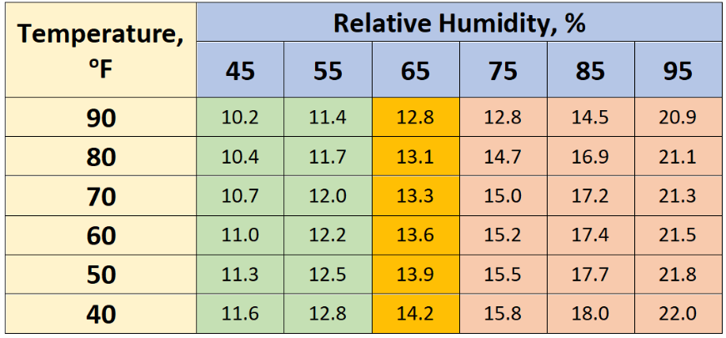
For this corn hybrid, the safe storage moisture contents are 14.2% at 40°F, and 13.3% at 70°F. Even a slight change, like storing the corn at 15% moisture at 70°F, can raise the relative humidity to 75%, increasing the risk of mold development and caking.
If grain is stored at high relative humidity during summer, there are several strategies to help protect your yields.
✅ Closely monitor grain conditions using systems such as AGI BinManager.
✅ Reduce moisture content to a level equivalent to 65% relative humidity at the storage temperature. Note that this may result in some weight loss due to additional drying.
✅ Reshuffling grain mass may be needed every 3-4 weeks during summer to avoid spoilage.
✅ Install insect traps in the headspace to monitor insect growth.
✅ Reduce insects attacking grain using proper pest management methods like bin cleaning, weedicide treatment around the bin, empty bin insecticide treatment or heat treatment.
✅ After filling a bin, treat the headspace with top-dressing chemicals. The EPA-approved protectants like Diacon, Centynal (Deltamethrin), or organically approved Diatomaceous Earth (DE) may be used.
Are there any warning signs indicating spoilage, insect activity, or moisture problems in the summer?
There are several indicators to watch for during the summer months that mean your bins may need immediate attention:
- Rapid temperature increases in localized areas of the bin—particularly where grain moisture is higher (relative humidity >65%)—can indicate mold growth, commonly referred to as a hotspot.
- Another indicator of mold growth spoilage in your grain mass is CO2 levels exceeding 2000 ppm.
- Every two weeks during summer, collect insects from the insect trap installed on the headspace and identify what type of insect it is. A few beetles spotted in these traps are not too concerning, but even one or two weevils showing up means it is time to fumigate.
When should customers consider sending grain samples for EMC testing?
The best time to send a grain sample for EMC testing is immediately after harvest. On average, it will take 2 to 3 weeks to complete the testing process. It can be time-consuming as there is no other option available.
Even though it might be a little late to use EMC testing for this year’s crop, it is still worth doing now. If the same hybrid is grown next year, the data will help optimize drying and storage right from the beginning of the season.
Find a Dealer or Installer
Find your nearest AGI Dealer or Installer by filling out the above filters.
Sorry, there are no results for your search - please change your criteria and try again